(ChatGPT)
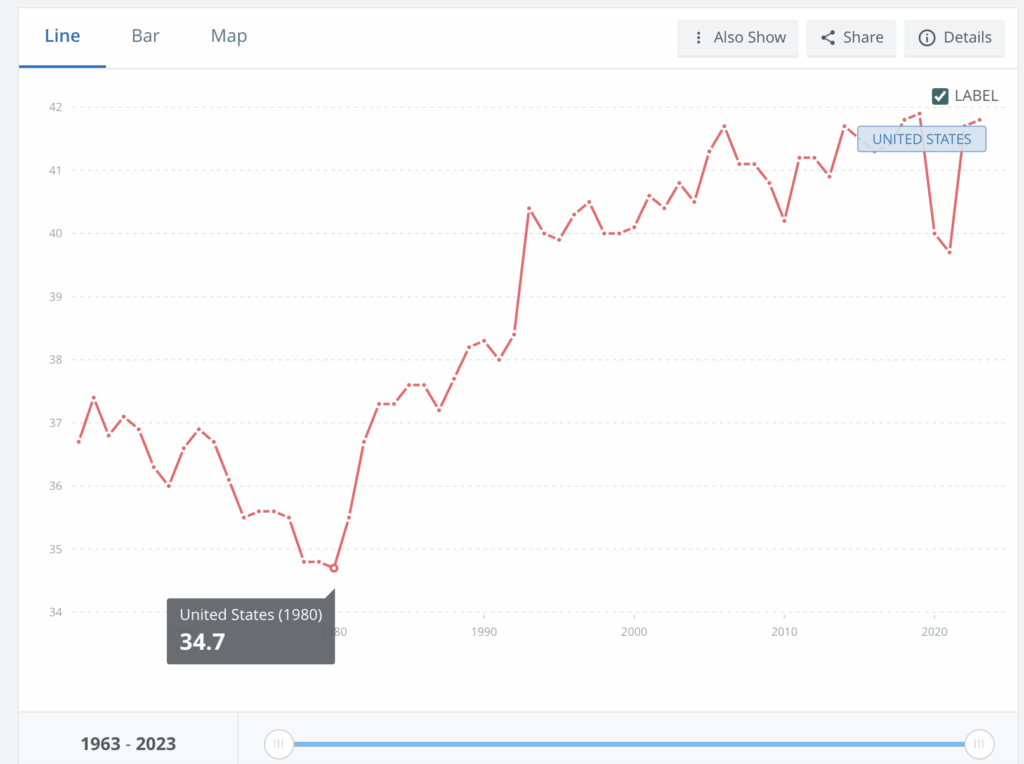
During the mid-20th century, wealth and income became more equally distributed than at almost any other time in modern U.S. history—a trend that reversed beginning in the 1980s.
📉
Postwar Wealth Trends: 1940s–1970s
From the late 1940s through the late 1970s, the share of national wealth held by the richest Americans declined significantly, while the middle class grew in size and prosperity. This redistribution was driven by:
- High marginal tax rates on top incomes and estates (top income tax rate was over 90% in the 1950s).
- Strong labor unions and collective bargaining.
- Progressive social policies (e.g., GI Bill, Social Security expansion).
- Rapid growth in real wages and homeownership for the middle class.
As noted by leading inequality scholars Thomas Piketty, Emmanuel Saez, and Gabriel Zucman, the share of wealth held by the top 0.1% fell from over 25% in the 1920s and 1930s to under 10% by the 1970s.
📄 Reference (Saez & Zucman 2016):
“The share of wealth owned by the top 0.1% peaked in the late 1920s at over 25%, fell to 7% in the 1970s, and has surged again since.”
🔗 https://gabriel-zucman.eu/files/SaezZucman2016QJE.pdf (p. 528)
Also see their data visualization of U.S. wealth shares:
🔗 https://wid.world/country/usa/
📊
Wealth Share of the Top 1%: A Declining Arc
According to the World Inequality Database (WID):
- In 1945, the top 1% owned roughly 30–35% of U.S. wealth.
- By 1978, that had dropped to around 22%.
- After 1980, their share began climbing again, reaching over 35% by 2020.
📊 Interactive chart of U.S. wealth inequality over time:
🔗 https://inequality.org/facts/wealth-inequality/
📘
Academic Consensus
Economist Heather Boushey writes in Unbound: How Economic Inequality Constricts Our Economy that the postwar period saw a flattening of wealth and income hierarchies. Similarly, Piketty (2014) in Capital in the 21st Century described this as a unique era of declining inequality due to policy choices, not just economic growth.
🔗 Piketty’s wealth inequality data and U.S. historical charts:
https://piketty.pse.ens.fr/en/graphs
✅
Conclusion
For several decades after WWII—roughly from the late 1940s to the late 1970s—the rich owned a declining share of national wealth. This trend resulted from a combination of progressive tax policies, labor empowerment, and broad-based economic growth. The trend reversed in the 1980s with the advent of trickle-down economics, deregulation, and tax cuts for the wealthy.
Back to Home
Back to “After Trickle Down” email