Thomas Piketty’s Theory About the Economy
(ChatGPT)
Thomas Piketty is a French economist who became famous for studying wealth and inequality. His book Capital in the Twenty-First Century (2013) made people around the world think harder about how money is shared in society.
📈 The Main Idea: r > g
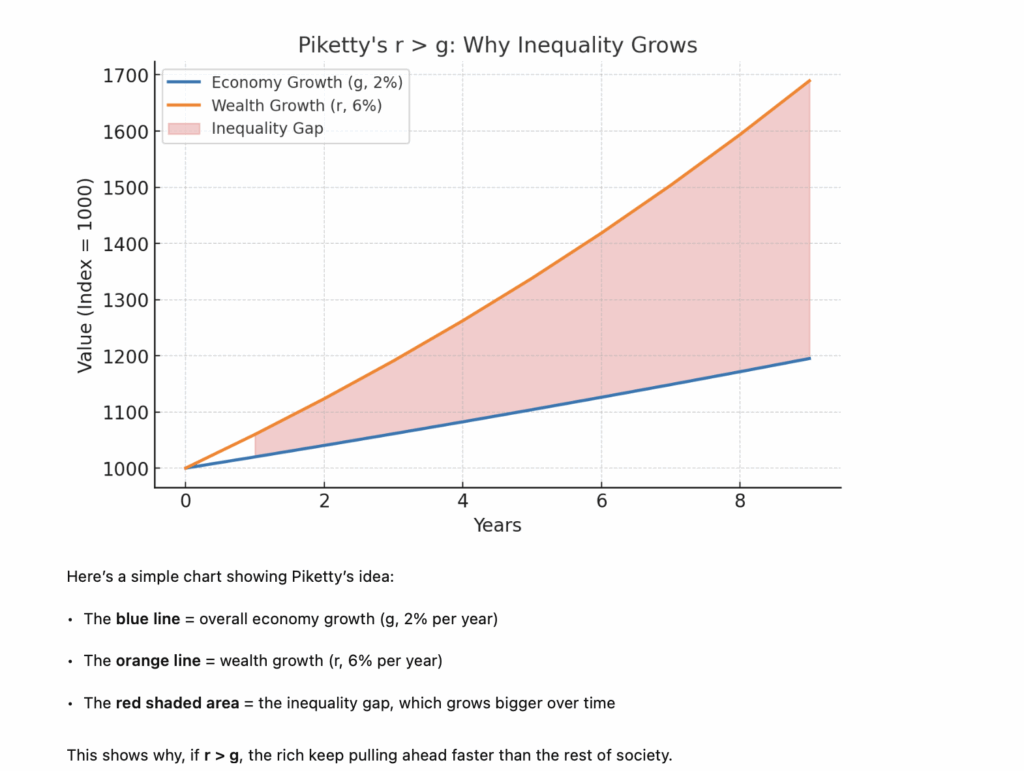
Piketty says that inequality (the gap between rich and poor) grows when the rate of return on wealth (r) is bigger than the growth of the economy (g).
- r = return on capital (like profits, dividends, or interest that rich people earn from investments)
- g = overall growth of the economy (wages, jobs, production)
If r > g, then rich people’s money grows faster than the economy, meaning they get richer while everyone else struggles to keep up.
👉 In simple terms: if billionaires’ investments grow faster than workers’ paychecks, inequality gets worse.
💰 Wealth Concentration
Piketty shows that in the 1800s and early 1900s, wealth became concentrated in just a few families. Wars, high taxes, and government spending after World War II reduced inequality for a while. But since the 1980s, inequality has been rising again in places like the United States and Europe.
🏛 What He Suggests
Piketty argues that to stop inequality from getting too extreme, countries should:
- Tax wealth progressively (higher taxes for very rich people).
- Improve education and opportunities for everyone.
- Share information about wealth (so governments and citizens can see who owns what).
🌍 Why It Matters
Piketty believes that too much inequality is dangerous for democracy. If the rich control most of the wealth, they also gain too much political power, which can weaken fairness and opportunity in society.
📚 References
- Piketty, Thomas. Capital in the Twenty-First Century. Harvard University Press, 2014. Publisher link
- Matthews, Dylan. “Thomas Piketty’s Capital, in 3 Graphs.” Vox (2014). Read here
- World Inequality Database. “Global Inequality Trends.” Visit here
- The Economist. “Piketty’s Capital.” (2014). Summary article
Back to