What’s wrong with the U.S.A?
(Chat GPT)
Much of the problem ties directly to the decades-long dominance of trickle-down economics and political gridlock. Here’s a concise overview that connects the dots:
🇺🇸 1. Concentration of Wealth and Power
Since the early 1980s, tax cuts for corporations and the wealthy — justified by “trickle-down” theory — have shifted national wealth upward.
- The top 1 % now hold over 30 % of all U.S. wealth, while the bottom 50 % share less than 3 %.
- Median real wages have been largely flat since the late 1970s despite massive productivity growth. (Sources: WID.world, Federal Reserve Distributional Accounts)
🏛️ 2. Weak Public Investment
Lower federal revenue (taxes / GDP ≈ 26 % vs 40–45 % in Finland or Denmark) means less spending on:
- Education and research
- Infrastructure and climate resilience
- Health care and family supports
That gap explains why U.S. life expectancy, infant mortality, and happiness rankings now lag behind other rich democracies.
(OECD, World Happiness Report 2024)
⚖️ 3. Political Polarization and Gridlock
The wealth imbalance feeds campaign financing and lobbying, amplifying corporate interests.
Shutdowns, debt-ceiling standoffs, and stalled reforms are symptoms of a system captured by moneyed elites more than by ordinary voters.
(Brookings Institution, Pew Research Center)
💥 4. The “Trickle-Down” Feedback Loop
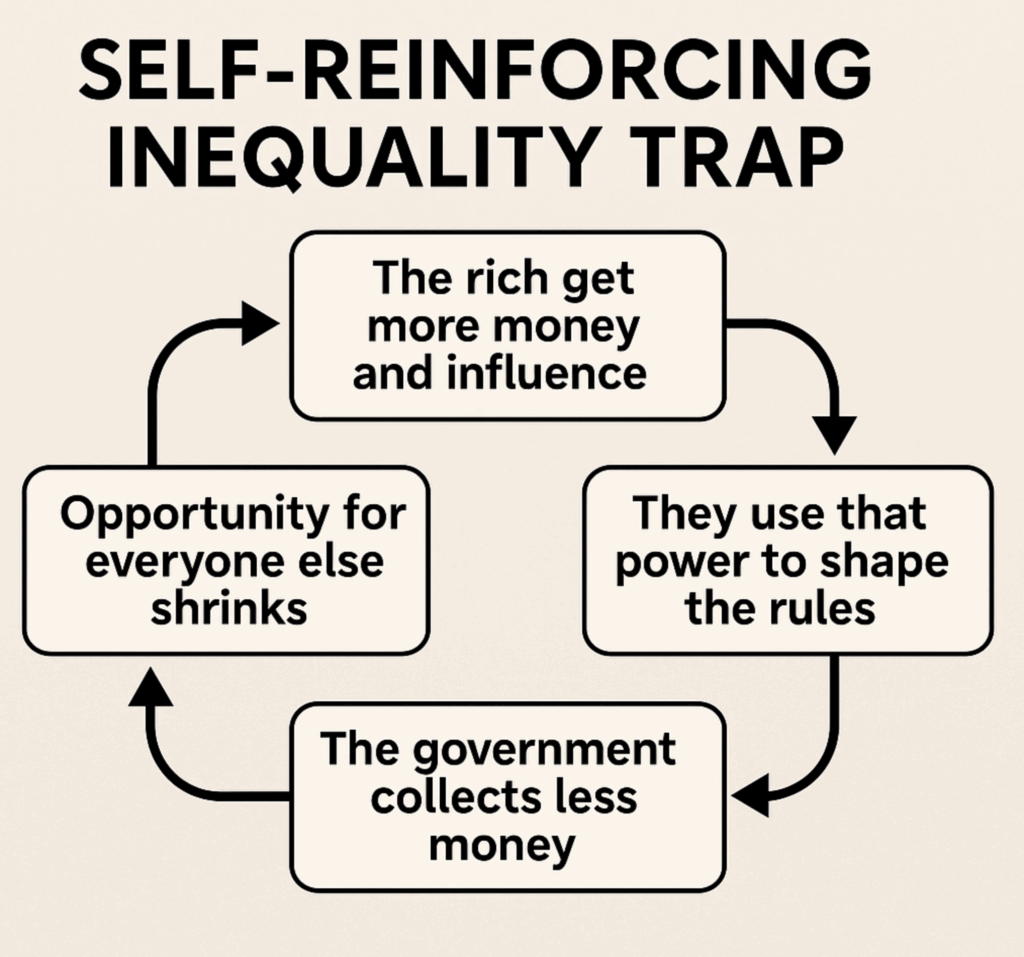
When tax cuts reduce revenue:
- Deficits rise →
- Calls for spending cuts follow →
- Cuts hit social programs and infrastructure →
- Inequality worsens →
- Political frustration grows.
That’s the cycle many economists (including at the IMF and OECD) now describe as a self-reinforcing inequality trap.
🌎 5. What’s Still Working — and Could Be Expanded
- The U.S. remains highly innovative and productive.
- Public investment in science, green energy, and broadband shows promise.
- Local democratic movements (e.g., campaign-finance reform, ranked-choice voting, community wealth initiatives) are slowly countering the imbalance.
Back to “Game Plan” email
Back to “Game Plan” flier