⚖️ What Is the “Self-Reinforcing Inequality Trap”?
(ChatGPT)
Summary
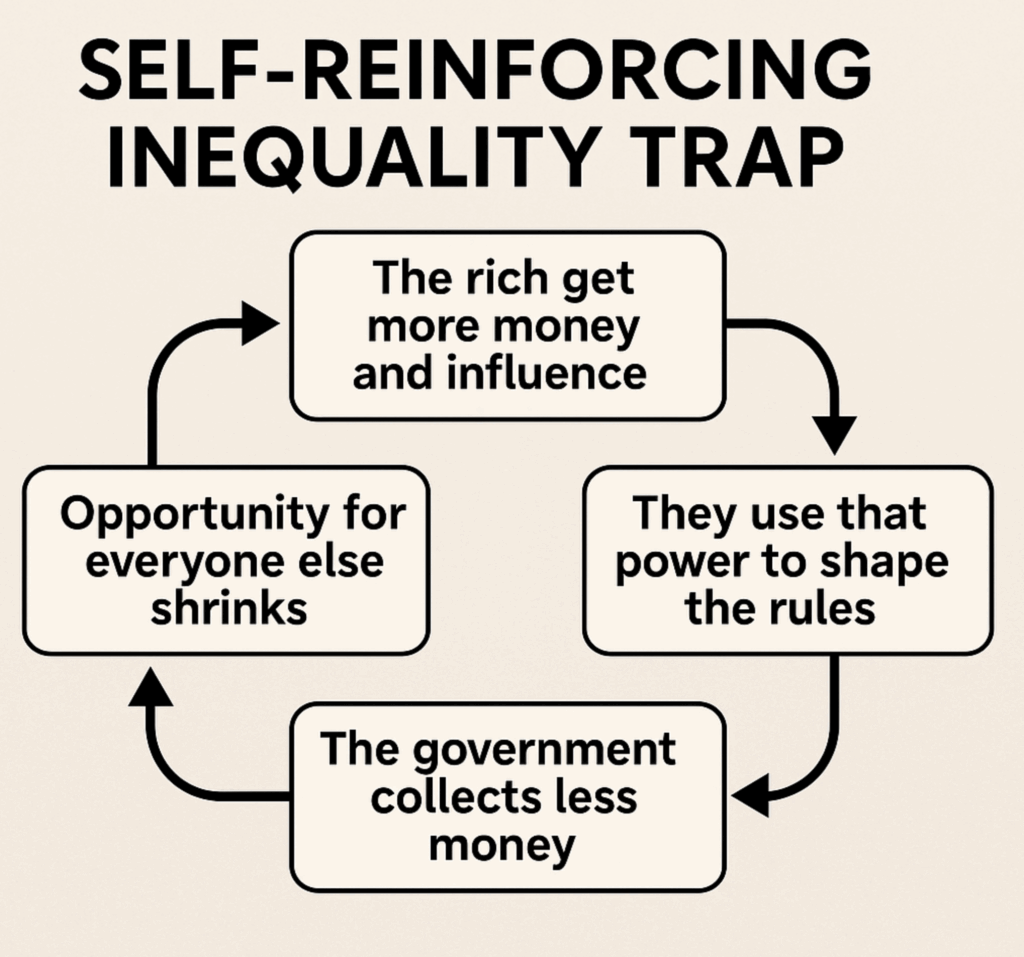
The Self-Reinforcing Inequality Trap
A self-reinforcing inequality trap occurs when economic and political power reinforce one another in a feedback loop. Wealth buys influence — through campaign donations, lobbying, and media control — which leads to laws and policies favoring the already wealthy. Those policies then further increase inequality, giving elites even more influence in the next cycle.
Over time, this dynamic erodes equal opportunity, weakens democracy, and creates what social scientists call a path-dependent equilibrium: the rich get richer not only because of markets, but because the political rules themselves tilt in their favor.
Modern examples include:
- Campaign finance concentration – a handful of donors providing most political funding.
- Regulatory capture – when industries write or block the rules meant to oversee them.
- Monopoly power – large corporations using their dominance to suppress competition and wages.
The result is a society where upward mobility stagnates and ordinary citizens lose confidence that democracy serves them.
What the Founders Tried to Prevent
America’s founders, despite their differences, shared a deep fear of economic aristocracy — the idea that concentrated wealth would inevitably lead to concentrated political power.
| What the Founders Said | What We See Today (data & links) |
|---|---|
|
“The balance of power in a society accompanies the balance of property.” — John Adams, Letter to James Sullivan (1776). Link: Founders Online URL: https://founders.archives.gov/documents/Adams/06-04-02-0091 |
In 2021, the top 1% of U.S. households earned 139× the income of the bottom 20%. Source: Inequality.org URL: https://inequality.org/facts/income-inequality/ Report: CBO, “Distribution of Household Income 2021” URL: https://www.cbo.gov/publication/60706 |
|
“The small landholders are the most precious part of a state.” — Thomas Jefferson to James Madison (1785). Link: Founders Online URL: https://founders.archives.gov/documents/Jefferson/01-08-02-0214 |
As of 2025 Q2, the bottom 50% of Americans hold only ~5.5% of total wealth. Source: Federal Reserve / FRED URL: https://fred.stlouisfed.org/release/tables?eid=813804&rid=453 |
|
“By a faction, I understand a number of citizens… united and actuated by some common impulse of interest, adverse to the rights of other citizens.” — James Madison, Federalist No. 10 (1787). Link: Yale Avalon Project URL: https://avalon.law.yale.edu/18th_century/fed10.asp |
In 2024, the top 100 donors gave ~73% of all super-PAC money (OpenSecrets). Source: OpenSecrets URL: https://www.opensecrets.org/elections-overview/biggest-donors?cycle=2024&view=om Also: “Dark money” reached a record $1.9 billion in 2024 (Brennan Center). Source: Brennan Center URL: https://www.brennancenter.org/our-work/research-reports/dark-money-hit-record-high-19-billion-2024-federal-races |
The founders’ warnings have come full circle. Today, as wealth concentrates in the hands of a few and political power increasingly depends on money, the United States risks reproducing precisely the kind of self-reinforcing hierarchy they fought to escape.
Economists and historians echo these concerns:
- Thomas Piketty (2014), Capital in the Twenty-First Century — argues that when the rate of return on capital exceeds economic growth, inequality becomes self-reinforcing.
- Joseph Stiglitz (2012), The Price of Inequality — shows how political capture by the rich distorts markets and democracy.
- IMF (2015), “Causes and Consequences of Income Inequality” — finds that excessive inequality reduces sustainable growth. (https://www.imf.org/en/Publications/Staff-Discussion-Notes/Issues/2016/12/31/Causes-and-Consequences-of-Income-Inequality-A-Global-Perspective-42986)
Why It Matters
The American Revolution sought to replace hereditary privilege with a system where citizens, not aristocrats, determined the future. The founders knew that liberty could not survive if wealth and power were allowed to merge.
Breaking today’s inequality trap therefore isn’t only an economic task — it’s a constitutional renewal: restoring the balance the founders envisioned between prosperity, fairness, and self-government.
Back to Rule by Money