(Image – ChatGPT)
Loving-Kindness Without Trying
( Prepared with research and writing assistance from ChatGPT (OpenAI).
Sources and references are provided so readers can examine the evidence for themselves. )
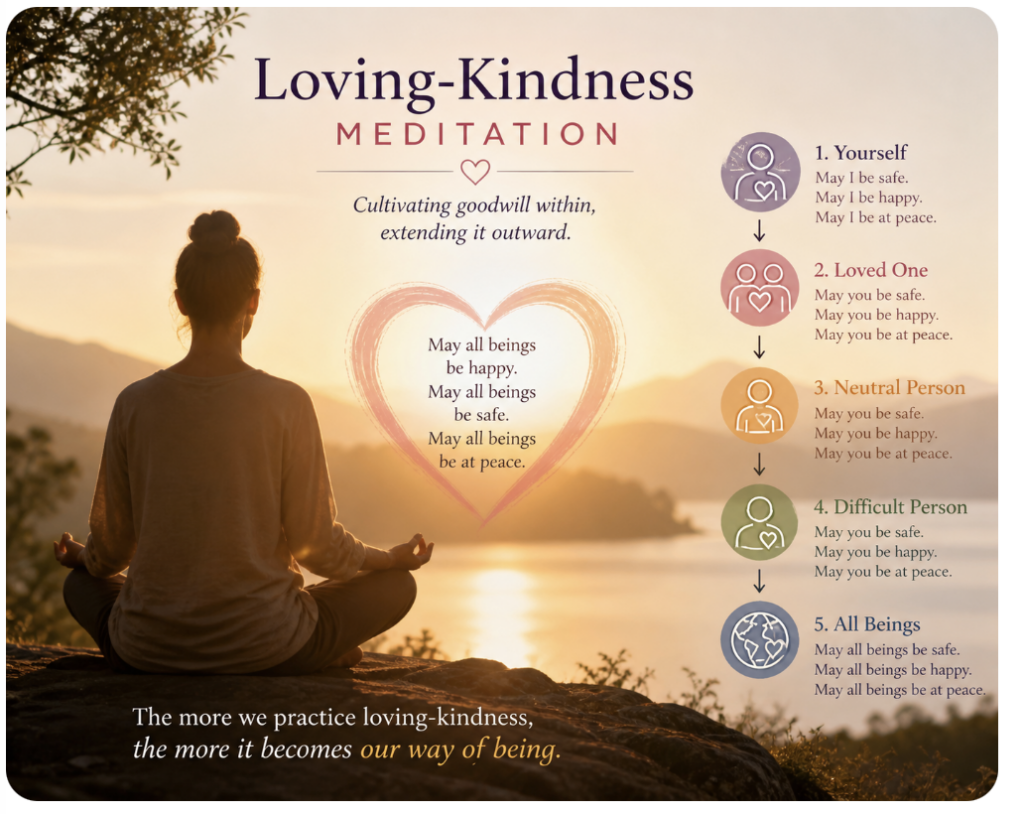
Loving-kindness meditation is often taught as a formal practice. A person sits quietly and silently repeats phrases such as: may I be safe, may I be peaceful, may I be healthy, may I live with ease. Then the same wishes are extended outward: to a loved one, a stranger, a difficult person, and finally to all beings.
In Buddhist tradition, this practice is called mettā, usually translated as loving-kindness, goodwill, or benevolent friendliness. The Greater Good Science Center describes loving-kindness meditation as a practice that strengthens feelings of kindness and connection toward others, often by mentally sending goodwill, kindness, and warmth through repeated phrases.
But loving-kindness is more than a technique. It is a way the mind can learn to rest in goodwill. It is a state in which one is no longer fighting oneself, fighting the world, or treating other beings as threats or obstacles. At its deepest, loving-kindness becomes a center of reality: a quiet conviction that life is not fundamentally hostile, that other beings matter, and that peace is possible.
What is remarkable is that this state can sometimes be learned without directly trying to learn it.
The Accidental Path
I did not set out to learn loving-kindness meditation. I did not sit with a script. I did not repeat phrases. I did not begin by thinking, “May all beings be happy.”
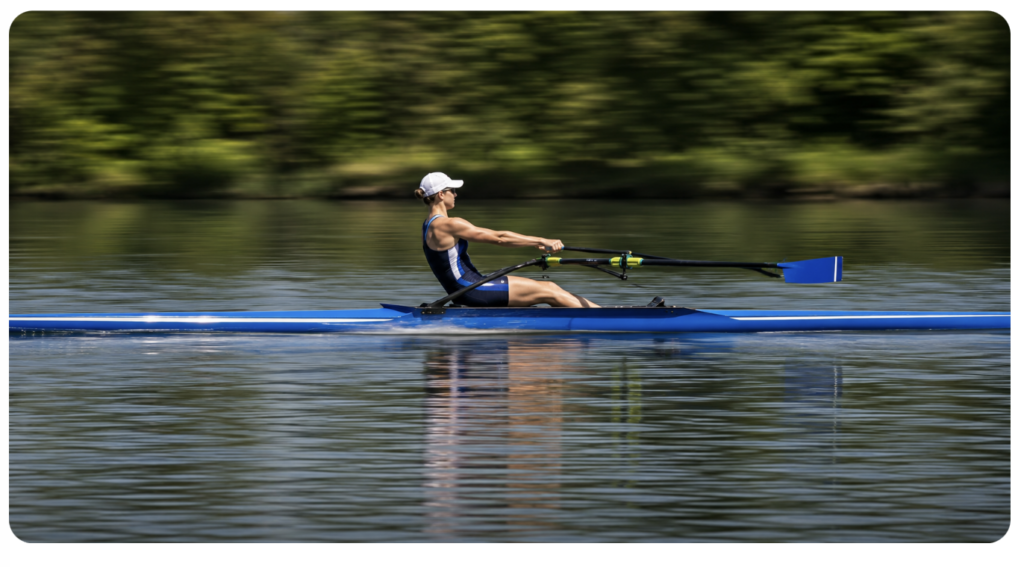
Instead, I relaxed my mind and concentrated on rowing.
My attention went to rowing technique: the catch, the drive, the release, the recovery, the rhythm of the stroke. I watched the behavior of the boat. I noticed how it moved through the water, how balance changed, how pressure on the oars affected glide, how a small disturbance in the body showed up in the shell. The task required attention, but not strain. It required discipline, but also softness.
Over time, the mind became quieter. The body, boat, water, and attention began to feel less separate. Rowing well required cooperation with reality. If I forced the stroke, the boat resisted. If I relaxed into proper form, the boat responded. The water gave immediate feedback. The boat became a teacher.
After perhaps twenty two-hour sessions, something had changed. I was not merely calmer while rowing. I found myself constantly at peace with myself and the world.
That is the important point. The practice had moved beyond the boat. A change of attention had become a change of being.
Why Rowing Can Teach Peace
Rowing is not usually described as meditation, but it can become meditative. It asks for rhythmic movement, relaxed concentration, bodily awareness, and sensitivity to feedback. The rower must be alert but not tense. The movement must be strong but not violent. The boat rewards balance and punishes agitation.
In that sense, rowing can teach the same lesson that many contemplative traditions teach: stop fighting reality.
This does not mean becoming passive. A good rower works hard. But the effort is integrated. The body is not at war with itself. The mind is not scattering in every direction. The stroke becomes cleaner as unnecessary tension drops away.
That dropping away matters. Much of ordinary suffering comes from unnecessary resistance: resentment, self-criticism, fear, impatience, comparison, and the constant inner commentary that turns experience into struggle. When the mind becomes absorbed in a disciplined but peaceful activity, those habits can loosen.
Mindfulness is often defined as awareness of one’s internal states and surroundings. The American Psychological Association describes mindfulness as awareness that can help people observe thoughts, emotions, and present-moment experience without being captured by automatic reactions. Rowing can cultivate exactly that kind of awareness: the body, the boat, the water, the breath, the pressure, the timing, the correction.
The result may not feel like “meditation” in the formal sense. But the mind is being trained.
Loving-Kindness Without Words
Traditional loving-kindness meditation uses words. The words matter because they shape intention. They turn the mind toward goodwill.
But words are not the only path to goodwill.
Sometimes loving-kindness emerges when the nervous system stops defending itself. When the mind grows quiet and the body feels safe, the heart may soften naturally. A person who is no longer clenched in self-protection may begin to feel less hostility toward the world. Peace with oneself can become peace toward others.
That may be why an indirect practice can lead to loving-kindness. The rower does not say, “May I be peaceful.” But the body learns peace. The rower does not say, “May I live in harmony.” But the boat teaches harmony. The rower does not say, “May I stop fighting the world.” But the water shows that force without sensitivity fails.
In formal loving-kindness meditation, goodwill is cultivated through phrases. In rowing, music, gardening, knitting, walking, or craft, goodwill may be cultivated through rhythm, attention, and release.
The route is different. The destination can be similar.
From Concentration to Compassion
A person might ask: how does concentration on rowing technique become love or kindness?
The answer is that attention changes the self. When the mind is scattered, the self feels anxious and defended. When the mind settles, the self becomes less rigid. The boundary between “me” and “the world” softens.
This is not mystical in a vague sense. It is something people often experience in deep absorption. Psychologist Mihaly Csikszentmihalyi popularized the idea of flow, a state in which a person is deeply involved in an activity, with focused attention and a reduced sense of self-consciousness. Flow is not the same thing as loving-kindness, but it can open a similar door: less ego, more presence.
In rowing, the self that worries, judges, complains, and compares may temporarily step aside. What remains is attention. Stroke follows stroke. The boat moves. The water responds. The world is no longer an enemy; it is a partner.
From there, compassion can arise naturally. A mind at peace is less likely to attack. A person who has learned gentleness toward experience may become gentler toward people. A person who no longer feels internally threatened may become less defensive, less irritable, and more patient.
Research on loving-kindness meditation suggests that even brief practice can increase positive social emotions and feelings of connection. One study found that loving-kindness meditation increased social connectedness and positivity toward unfamiliar people. A review in Frontiers in Psychology concluded that loving-kindness meditation interventions are effective in enhancing positive emotions, while also noting that more research is needed on how and why the effects occur.
My experience suggests one possible explanation: loving-kindness may grow when the mind practices non-hostility. Whether that happens through formal phrases or through deep harmonious attention, the heart can learn the same direction.
A State of Being
The deepest form of loving-kindness is not an exercise. It is a state of being.
At first, one may practice loving-kindness for ten minutes. Then, perhaps, the practice begins to color the rest of the day. Eventually, one may not need to “do” loving-kindness in order to feel it. It becomes the background tone of consciousness.
That does not mean permanent bliss. It does not mean one never feels anger, grief, fear, or frustration. It means that beneath ordinary emotions there is a steadier center. One is less easily thrown into hostility. One is quicker to return to balance. One feels more fundamentally at home in the world.
This is what happened through rowing. The peace did not remain confined to practice. It generalized. It became ordinary. The boat had trained the mind to settle, and the settled mind discovered goodwill.
In that sense, loving-kindness is not something artificially added to life. It is something uncovered when agitation falls away.
The Body as Teacher
Many people imagine spiritual practice as something purely mental. But the body may be one of the great teachers of peace.
Breathing, posture, rhythm, balance, and movement all affect the mind. A tense body encourages a tense mind. A balanced body can invite a balanced mind. Practices such as yoga, tai chi, walking meditation, dance, martial arts, rowing, and even skilled manual labor can train attention through the body.
The body also prevents spiritual practice from becoming abstract. It gives immediate feedback. In rowing, if the mind becomes impatient, the stroke suffers. If the body tightens, the boat loses efficiency. If attention wanders, balance changes. The body and boat reveal the mind.
This is a powerful form of instruction. It is not moralistic. It does not scold. It simply shows.
Not Everyone Needs the Same Door
Some people find loving-kindness through formal meditation. Some find it through prayer. Some find it through caregiving. Some find it through nature. Some find it through music, craft, service, or sport.
The door matters less than the transformation.
The essential movement is from agitation to calm, from self-absorption to connection, from resistance to acceptance, from hostility to goodwill. A practice that reliably moves a person in that direction has spiritual value, whether or not it looks religious.
This is important because many people are put off by formal meditation. They may think they are bad at it. They may dislike sitting still. They may become discouraged when the mind wanders. But the mind can be trained in many ways. A person may learn loving-kindness while rowing without ever calling it meditation.
Conclusion
Loving-kindness meditation is traditionally practiced by intentionally sending goodwill to oneself and others. That remains a beautiful and powerful method. But loving-kindness can also be learned indirectly.
While relaxing the mind and concentrating on rowing technique and the behavior of the boat, I found that attention became peace. After many hours of practice, the peace moved beyond rowing. I became constantly at peace with myself and the world.
That experience taught me that loving-kindness is not merely a set of phrases. It is a condition of the heart. It can be cultivated deliberately, but it can also emerge when the mind becomes quiet, the body becomes harmonious, and the self stops fighting reality.
The boat moved through the water. The mind learned to move through life.
And without trying to learn loving-kindness, I learned something very close to it.
References
- Greater Good Science Center, University of California, Berkeley. “Loving-Kindness Meditation.” Greater Good in Action.
https://ggia.berkeley.edu/practice/loving_kindness_meditation - Greater Good Science Center, University of California, Berkeley. “Loving-Kindness Meditation — Printable Practice.”
https://ggia.berkeley.edu/practice/practice_as_pdf/loving_kindness_meditation?printPractice=Y - American Psychological Association. “Mindfulness.”
https://www.apa.org/topics/mindfulness - American Psychological Association. “Mindfulness Meditation: A Research-Proven Way to Reduce Stress.”
https://www.apa.org/topics/mindfulness/meditation - Hutcherson, Cendri A., Emma M. Seppala, and James J. Gross. “Loving-Kindness Meditation Increases Social Connectedness.” Emotion, 2008. PubMed.
https://pubmed.ncbi.nlm.nih.gov/18837623/ - Zeng, Xianglong, et al. “The Effect of Loving-Kindness Meditation on Positive Emotions: A Meta-Analytic Review.” Frontiers in Psychology, 2015.
https://www.frontiersin.org/journals/psychology/articles/10.3389/fpsyg.2015.01693/full
Back to Peace is Possible