Wealth Distribution
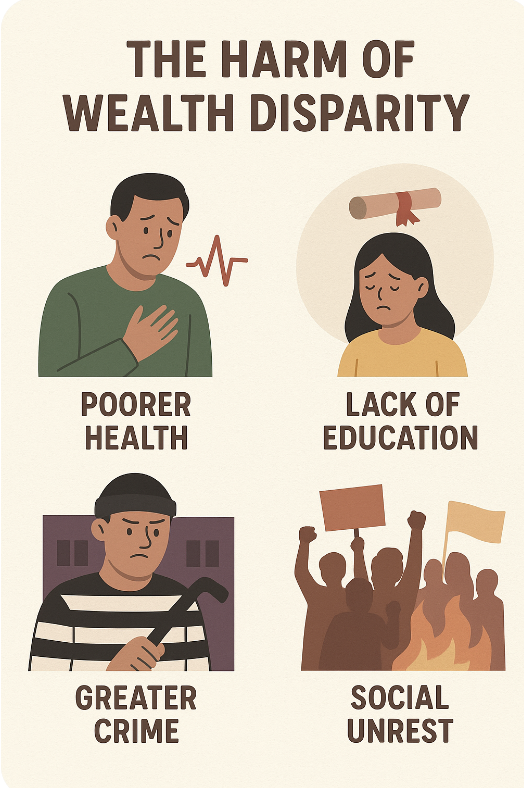
After 43 years of trickle down, the USA now has one of the most unequal wealth distributions of the major nations.
The Gini index,
also known as the Gini Coefficient, measures income inequality within a country or region.
If it’s zero, everybody has the same amount.
If it’s one, one person has all the wealth.
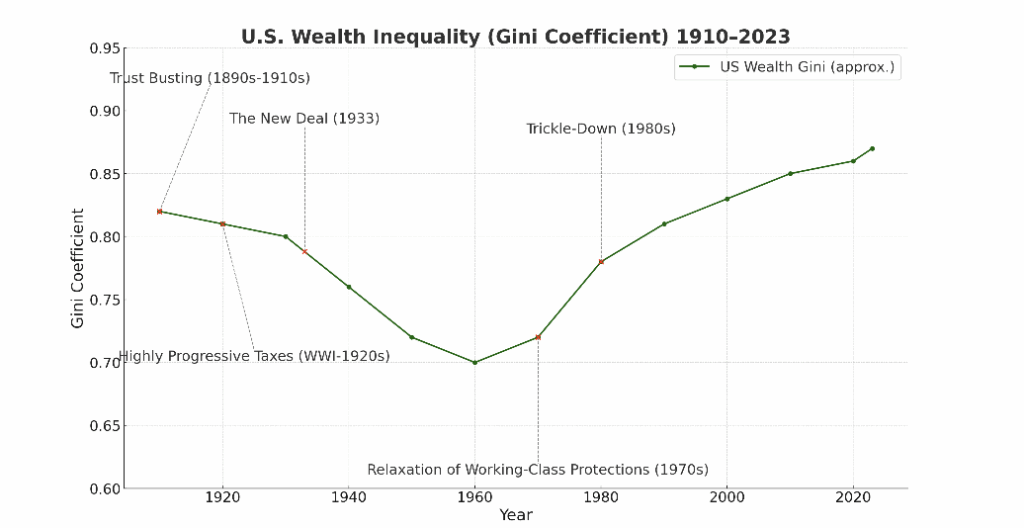
image – ChatGPT
________________
History of wealth Distribution in the US
________________
Wealth distribution in the United States in the second quarter of 2024.

Total Wealth = $160 trillion
Breakdown, who has how much.
________________
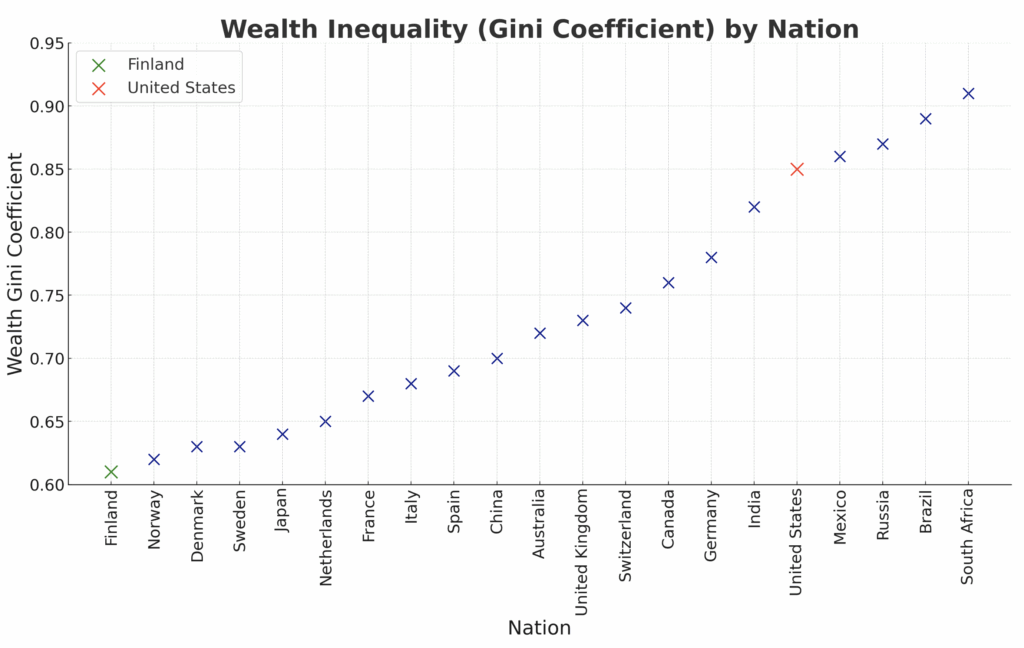
Comparison of U.S. Wealth Distribution with Other Developed Countries
(ChatGPT)
📊 Wealth Gini Coefficient Sources
- World Inequality Database (WID.world) Interactive database of wealth and income inequality metrics by country. 👉 https://wid.world
- OECD Wealth Distribution Database (where available) OECD data on household wealth distribution and inequality among member countries. 👉 https://www.oecd.org/statistics/wealth-distribution-database.htm
- World Bank – PovcalNet & Inequality Data Portal Global inequality and distribution indicators (mostly income, but sometimes cited alongside wealth data). 👉 https://data.worldbank.org/indicator/SI.POV.GINI
✅ Notes
- The United States (~0.85), Brazil (~0.89), Russia (~0.87), India (~0.82), and South Africa (~0.91) are consistently reported among the highest wealth Gini coefficients worldwide.
- Nordic countries (Finland, Norway, Sweden, Denmark) are among the lowest (~0.61–0.63).
- Numbers are rounded from the Credit Suisse Global Wealth Report and corroborated against WID.world.
Back to “Overthrow Rule by Money” email
Back to Flier
Back to Home
Back to “Game Plan” email
Back to After WWII Wealth was Shared More Equally
Back to “Fix the USA” email