also known as the Gini Coefficient, measures income or wealth inequality within a country or region.
If it’s zero, everybody has the same amount.
If it’s one, one person has all the wealth.
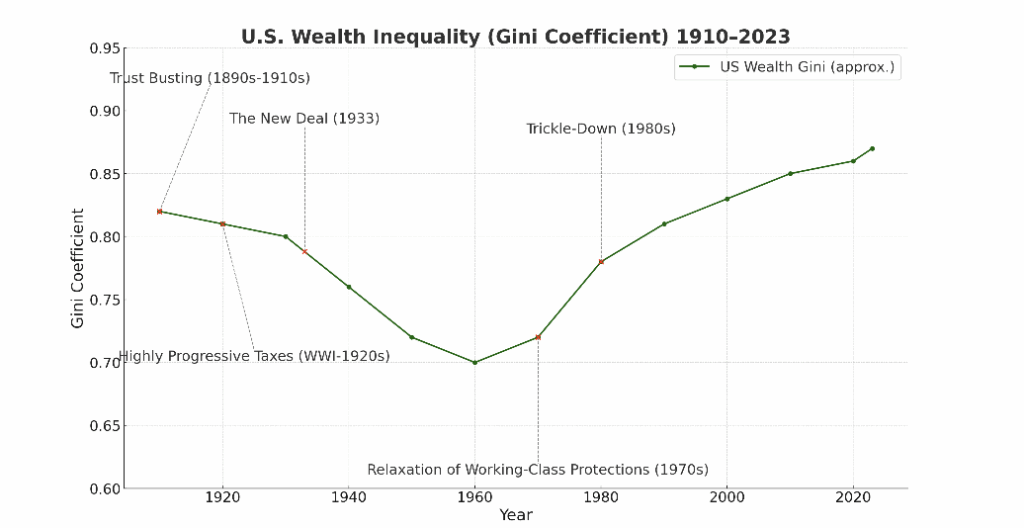
(ChatGPT – image and text))
Quick Summary: Wealth Inequality in the U.S.
- Gilded Age (late 1800s): Robber barons amassed vast wealth; many workers struggled. Inequality was very high. 👉 https://www.history.com/topics/19th-century/gilded-age
- Progressive Era: Trust busting and labor reforms began protecting workers. Highly progressive income taxes were imposed. 👉 https://www.archives.gov/milestone-documents/sherman-anti-trust-act
- The New Deal: Public programs and protections reduced inequality. 👉 https://www.fdrlibrary.org/great-depression-new-deal
- The Great Compression: Inequality dipped; working and middle classes grew stronger. They gained much more of the nation’s wealth. 👉 https://inequality.org/facts/income-inequality/
- Since the 1970s: Worker protections weakened; unions shrank, wages lagged, safety nets were weakened. 👉 https://apnews.com/article/1d9ce765edef24211b5160d55b3f9c90
- 1980s–today – Trickle-Down: Inequality surged under tax cuts and deregulation. 👉 https://gabriel-zucman.eu/files/SaezZucman2014.pdf 👉 https://www.imf.org/external/pubs/ft/sdn/2015/sdn1513.pdf 👉 https://wid.world
- Conclusion: Ending trickle-down (going back to highly progressive income tax rates) would make it possible to free vast resources to invest in schools, health, housing, and climate action—moving toward a more just and prosperous society for all.
________________
The History of Wealth Inequality in the United States
The Gilded Age and the Robber Barons
In the late 1800s, during the Gilded Age, a few powerful men—like Rockefeller, Carnegie, and J.P. Morgan—became extremely wealthy, while many workers lived in poverty.
👉 https://www.history.com/topics/19th-century/gilded-age
Trust Busting and Progressive Reforms
By the early 1900s, Americans pushed back. Presidents like Theodore Roosevelt used trust busting to break up monopolies. Workers fought for safer workplaces, shorter hours, and union rights—important protections for the working class.
👉 https://www.archives.gov/milestone-documents/sherman-anti-trust-act
The Great Depression & the New Deal
When the Great Depression hit in the 1930s, inequality made things worse. Franklin D. Roosevelt’s New Deal responded with programs like Social Security, public jobs, and stronger labor protections.
👉 https://www.fdrlibrary.org/great-depression-new-deal
The Great Compression (1940s–1970s): A Dip in Inequality
From the 1940s through the 1970s, inequality shrank. This is called the Great Compression. During these decades:
- Unions were strong
- Wages rose with productivity
- The government invested in infrastructure, education, and public services
- Taxes on the richest were high
Economists point to a dip in the Gini index at this time—inequality measured by that metric was lower than in many other periods. Middle-class families thrived.
👉 https://inequality.org/facts/income-inequality/
Erosion of Working-Class Protections
Starting in the 1970s, many protections began to slip away:
- Unions weakened. Fewer workers were unionized, reducing their bargaining power. 👉 https://apnews.com/article/1d9ce765edef24211b5160d55b3f9c90
- Minimum wage didn’t keep pace. Paychecks lost ground vs. cost of living. 👉 https://www.dol.gov/agencies/whd/minimum-wage/history/chart
- Safety nets were cut. Programs that supported working families—welfare, housing assistance, job training—saw reductions. 👉 https://www.brookings.edu/wp-content/uploads/2025/05/20250501_THP_SafetyNet_Paper.pdf
As these protections eroded, inequality began rising again.
The Trickle-Down Era (1980s–Present)
From the 1980s onward, “trickle-down economics” became dominant: big tax cuts for corporations and the rich, deregulation, and a belief that growth at the top would benefit everyone. In practice, much of the benefit stayed with the wealthy. Inequality rose sharply.
👉 https://www.imf.org/external/pubs/ft/sdn/2015/sdn1513.pdf
Conclusion: Ending Trickle-Down Would Free up a Whole Lot of Wealth
If the U.S. moved away from trickle-down policies and toward progressive taxation, stronger labor protections, and public investment, billions of dollars would be unlocked. Wealth currently concentrated at the top could instead fund:
- Universal healthcare
- Free higher education
- Better public schools and universities
- More affordable housing
- Fighting climate change
- Sustainable infrastructure
In effect, the country could reclaim some of the wealth that now sits unused at the top, making the economy work more fairly and broadly—much like what happened during the Great Compression.
Back to Home
Back to Flier
Back to Wealth email