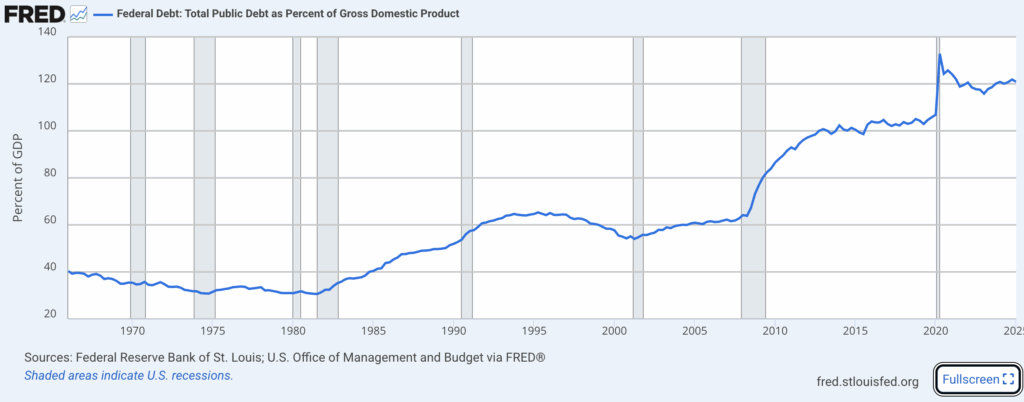
The National Debt between 1965 and Now
(ChatGPT)
The graph actually shows debt/GDP which measures how hard it will be to pay off the debt.
📉
Explanation
After World War II, the U.S. government owed a lot of money—more than the value of everything the country made in a year (119% of the economy in 1946) because of the huge cost of the war. But over the next 35 years, that number went down a lot. By 1981, the debt was only about 31% of the economy. This didn’t happen because the government paid off all the debt—it’s just that the economy grew faster than the debt, so the debt became a smaller part of the total.
This trend is clearly visible in official data:
- Congressional Budget Office (CBO) chart of federal debt as a % of GDP (Figure 1): 👉 https://www.cbo.gov/publication/58863
- U.S. Treasury / FRED data from the St. Louis Federal Reserve Bank: 👉 https://fred.stlouisfed.org/series/GFDEGDQ188S
📊
Reasons for the Decline
- Strong postwar economic growth: The U.S. experienced sustained economic expansion during the postwar decades—often called the “Golden Age of Capitalism.”
- Moderate inflation: Mild inflation helped erode the real value of debt.
- Stable or modest budget deficits: Until the Reagan tax cuts of the early 1980s, deficits were relatively contained.
- No large-scale military spending like WWII: Though the Cold War required defense budgets, nothing approached WWII levels.
As economists Carmen Reinhart and Kenneth Rogoff observed in their book This Time is Different (2009), many advanced economies, including the U.S., brought down wartime debt burdens largely through growth, inflation, and financial repression, rather than repayment.
📘
Additional References
- U.S. GAO Report on Historical Debt Trends: 👉 https://www.gao.gov/assets/gao-21-275sp.pdf (see page 9)
- Brookings Institution summary of debt history: 👉 https://www.brookings.edu/articles/deficits-and-debt-after-world-war-ii/
- Center on Budget and Policy Priorities – historical context: 👉 https://www.cbpp.org/research/federal-budget/policy-basics-federal-budget-101
✅
Conclusion
The debt-to-GDP ratio fell dramatically from 1946 through the early 1980s, supported by strong growth, controlled spending, and a favorable macroeconomic environment.
Back to home
Back to “After Trickle Down” Email