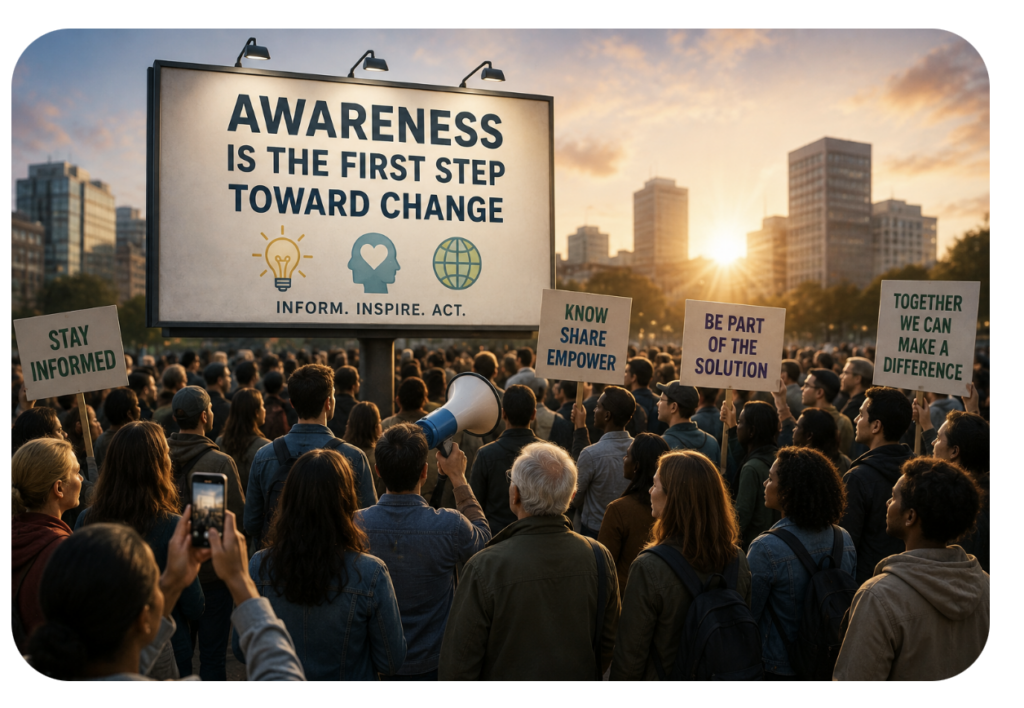
We Must Raise Public Awareness: Restoring Government of, by, and for the People
(ChatGPT)
Summary
Many Americans believe that government no longer responds equally to ordinary citizens and that wealthy interests exercise disproportionate influence over public policy. Whether or not one agrees with every aspect of that view, political scientists have documented that organized economic interests often have greater influence on federal policy than average citizens. If citizens wish to restore a government that is more responsive to the public, one essential step is raising public awareness—helping people understand how political influence works and what lawful, democratic actions citizens can take to increase their own influence.
This is not easy. Political communication is shaped by enormous expenditures on advertising, lobbying, public relations, and media campaigns. As a result, many important issues receive limited public attention while others dominate the news cycle. Citizens therefore cannot rely solely on traditional information channels. They must also communicate directly with one another through conversations, civic organizations, community meetings, letters, social media, and other peaceful democratic means.
We Must Raise Public Awareness
Abraham Lincoln described democracy as government “of the people, by the people, for the people.” That ideal depends on an informed public.
Democracy cannot function well if large numbers of voters do not understand how public policy is made, who has influence, and what ordinary citizens can do to participate effectively.
Throughout American history, reform movements have depended on public education. The abolition movement, women’s suffrage, labor reforms, the civil rights movement, environmental protection, and marriage equality all required years of public discussion before major legislative changes occurred.
Ideas spread before laws change.
Political Influence Is Unequal
Political scientists have spent decades studying whose preferences are reflected in public policy.
One of the best-known studies, by Martin Gilens and Benjamin Page, examined nearly 1,800 federal policy decisions. They concluded that organized interest groups and economic elites generally have much greater influence over federal policy outcomes than average citizens acting individually.
Their study does not conclude that ordinary citizens have no influence. Elections remain important, and broad public opinion can still matter—especially when it becomes highly organized and politically salient. But the research suggests that wealth and organized interests often enjoy structural advantages in influencing policy.
Other research has documented the extensive role of:
- lobbying
- campaign spending
- political advertising
- public relations
- think tanks
- revolving-door employment between government and industry
These activities are generally legal and protected to varying degrees under U.S. law, but together they can amplify the voices of well-funded interests.
Information Is Also a Source of Power
Influence does not come only from money.
It also comes from controlling which issues receive attention.
Large corporations, advocacy organizations, political campaigns, and wealthy donors spend billions of dollars each election cycle on advertising, messaging, polling, consulting, and media outreach.
News organizations must also make choices about what to cover, often under economic pressures and competitive incentives.
As a result, some issues receive constant attention while others receive relatively little discussion.
This does not necessarily involve conspiracy. It reflects the combined effects of financial incentives, institutional priorities, audience preferences, and organized advocacy.
For citizens, the practical lesson is clear:
Important public issues may not automatically receive the sustained attention they deserve.
Public Awareness Has Changed History
Many of America’s greatest reforms began with citizens educating one another.
Examples include:
- abolition of slavery
- women’s right to vote
- child labor laws
- food and drug safety laws
- Social Security
- Medicare
- the Civil Rights Act
- the Voting Rights Act
- environmental protections
None of these reforms occurred because powerful interests voluntarily gave up influence.
They occurred because enough citizens became informed, organized, and politically active to persuade elected officials that change had broad public support.
Citizens Must Also Communicate Directly
If citizens believe important issues are receiving insufficient attention, they are not powerless.
They can communicate directly with other citizens through lawful democratic means, including:
- conversations with family and friends
- civic organizations
- public meetings
- letters to editors
- local newspapers
- community forums
- educational websites
- books and articles
- social media
- peaceful demonstrations
- letters and emails to elected officials
History shows that person-to-person communication often plays a decisive role in changing public opinion.
Trust is frequently built through conversations among people who already know one another.
Public Understanding Can Change Political Incentives
Members of Congress ultimately seek election and reelection.
When enough constituents become informed about an issue and communicate consistently with their elected representatives, political incentives change.
Individual messages rarely transform policy.
Large numbers of informed voters, acting together over time, often do.
This is why many successful reform movements have emphasized public education before legislative change.
Democracy Requires an Informed Public
The Constitution provides mechanisms for self-government.
Whether those mechanisms produce responsive government depends largely on public participation.
Citizens who educate themselves, discuss issues respectfully, verify facts, participate in elections, and communicate with their representatives strengthen democratic government.
Restoring confidence in democratic institutions therefore depends not only on laws and elections, but also on the willingness of citizens to understand public issues and help one another understand them.
Democracy works best when informed citizens actively participate.
Conclusion
Money, organization, and professional advocacy have become important features of modern American politics. Research suggests that these forces often provide wealthy and organized interests with significant advantages in influencing public policy.
Yet history also demonstrates that informed citizens remain capable of producing profound democratic change.
Every major reform movement in American history began by changing minds before changing laws.
If Americans wish to restore a government that is more responsive to ordinary citizens, raising public awareness is not merely helpful—it is indispensable.
No institution can substitute for an informed electorate. Citizens themselves must participate in educating one another, evaluating evidence critically, and engaging peacefully in the democratic process. When enough people understand both the challenges and the democratic tools available to them, they can shape the political incentives that drive representative government.
Printable References
Abraham Lincoln. Gettysburg Address (1863).
https://www.archives.gov/milestone-documents/gettysburg-address
Martin Gilens & Benjamin I. Page. “Testing Theories of American Politics: Elites, Interest Groups, and Average Citizens.” Perspectives on Politics, Vol. 12, No. 3 (2014), pp. 564–581.
https://doi.org/10.1017/S1537592714001595
Library of Congress. The Civil Rights Movement.
https://www.loc.gov/collections/civil-rights-history-project/
National Archives. The Constitution of the United States.
https://www.archives.gov/founding-docs/constitution
OpenSecrets. Follow the Money in Politics. Campaign finance, lobbying, and political spending databases.
https://www.opensecrets.org/
Congressional Research Service (CRS). Lobbying Congress: An Overview of Legal Provisions and Congressional Rules.
https://crsreports.congress.gov/
Pew Research Center. Public Trust in Government (ongoing research).
https://www.pewresearch.org/topic/politics-policy/government/
Robert D. Putnam. Bowling Alone: The Collapse and Revival of American Community. Simon & Schuster, 2000.
The Federalist Papers (especially Nos. 10 and 51), discussing factions, representation, and checks on concentrated power.
https://guides.loc.gov/federalist-papers
U.S. Census Bureau. Voting and Registration in the Election of November 2024 (or latest available edition), documenting patterns of civic participation.
https://www.census.gov/topics/public-sector/voting.html
Back to Home