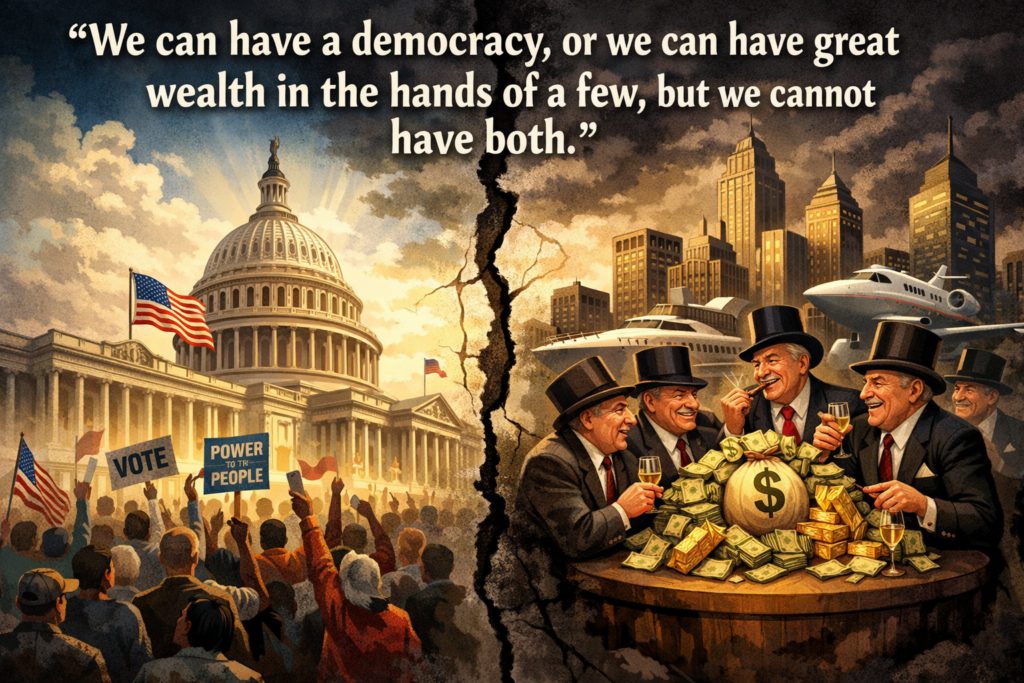
– Louis Brandeis, Supreme Court Justice, 1916-1939
(ChatGPT)
Summary
The USA rebelled against the world’s richest monarchy, rejecting rule by inherited wealth. Over time, concentrated fortunes re-emerged—from Gilded Age trusts to today’s mix of deregulation, weakened unions, top-tilted tax cuts, and big-money campaign finance—creating a feedback loop where wealth buys laws that create more wealth. The results are underfunded public goods, tilted markets, pay-to-play politics, and eroding civic trust. The remedy: fair progressive taxation, vigorous antitrust, public financing and transparency in elections, stronger labor rights, universal basics (health care and education), and strict ethics guardrails—so lawmaking returns to citizens, not checkbooks.
________________
One-liner: From king to cash: the USA must curb concentrated power to keep self-government real.
________________
Rule by Wealth in the USA
The story of the USA begins with a rebellion against the richest, most powerful monarchy on Earth. The revolutionaries of the 1770s did not merely reject a king; they rejected the idea that political power should flow from concentrated wealth and inherited status. They argued for self-government—rule by citizens, not by crown or cash. From the beginning, then, the country carried a double promise: freedom from monarchy and freedom from domination by the wealthy few.
From mistrust of aristocracy to the age of the trust
After independence, leaders in the new republic worried a lot about “moneyed interests.” Debates over the national bank, land speculation, and debt revealed a constant fear: that private fortunes might quietly capture public power. Those early anxieties proved well-founded in the Gilded Age of the late 1800s. Railroads, oil, steel, and finance consolidated into “trusts”—industrial empires run by a handful of magnates. These firms could set prices, block competitors, and lean on legislators. It wasn’t monarchy, but it rhymed with it: a small elite steering national life.
The USA’s answer was trust-busting and modern antitrust law. The Sherman Act, later strengthened by the Clayton Act and the creation of the Federal Trade Commission, asserted a basic civic rule: markets must be free from private rule. President Theodore Roosevelt called it “the square deal”—not anti-business, but firmly anti-domination.
The mid-century social contract
From the 1930s through the 1960s, the USA built a broad middle-class social contract. Labor protections, social insurance, infrastructure investment, the GI Bill, and a steeply progressive tax code dispersed both wealth and power. The public sector grew capable of mass projects—rural electrification, highways, research universities—while the private sector thrived in competitive, innovative markets. Imperfect as it was, this model checked the political power of concentrated wealth and expanded real freedom for ordinary families.
The long turn back to concentration
Beginning in the late 1970s and 1980s, policy took a different turn. Deregulation, a sustained decline in union power, and tax cuts tilted to the top reshaped the economy. The guiding story—often called “trickle-down”—promised that if the wealthiest paid less and big firms faced fewer rules, prosperity would spill over to everyone. What spilled over instead was political influence. As wealth reconcentrated, so did the capacity to shape the rules: through professional lobbying, think-tank funding, media ownership, and increasingly expensive elections.
Campaign finance doctrine added fuel. Court decisions that treated money as protected political “speech” supercharged private financing of public office. The cost of winning national seats soared; viable campaigns increasingly required major donors and allied groups. The result is a feedback loop:
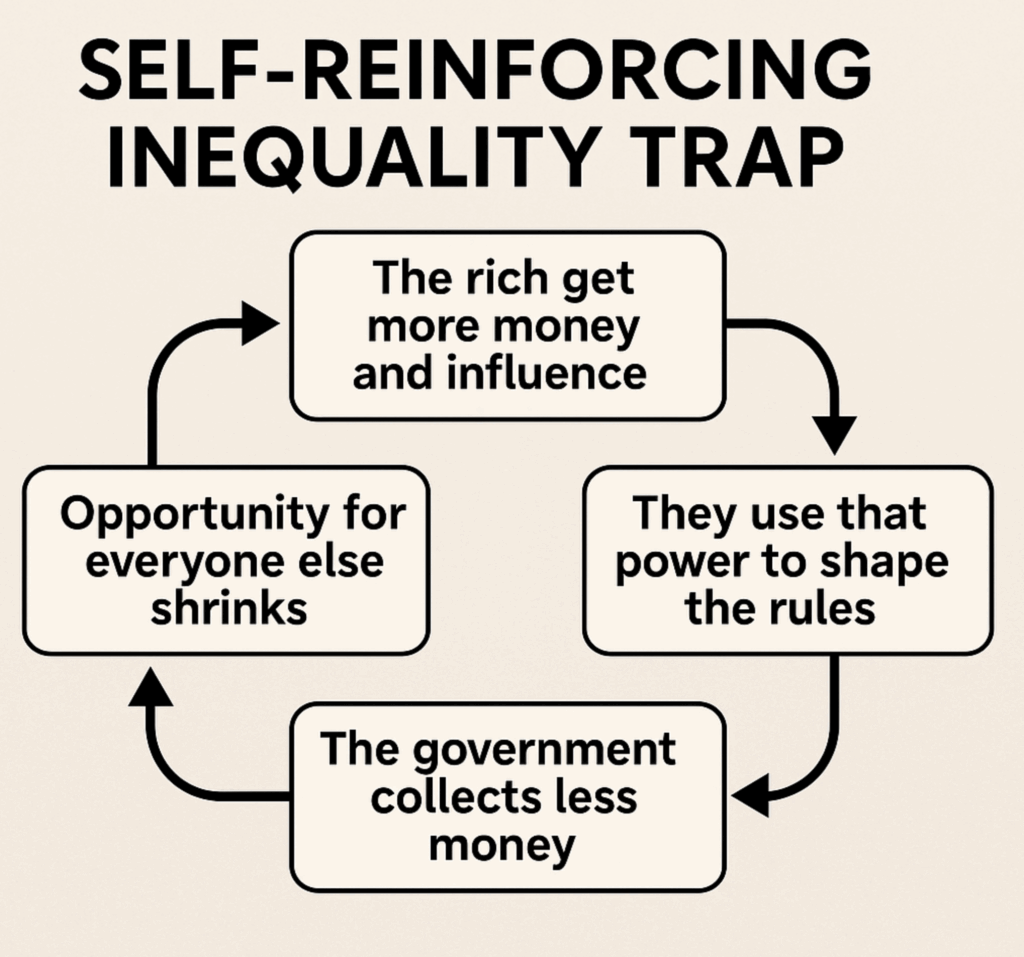
- More concentrated wealth →
- More influence over elections and legislation →
- Rules that protect and expand that wealth →
- Even more concentration.
That is how the USA drifts from self-rule toward rule by wealth—not by decree, but by budget line.
What rule by wealth looks like
- Public priorities shrink. When private fortunes dominate the political conversation, public goods—health care, higher education, childcare, transit, housing—are framed as “too expensive,” even as tax advantages and regulatory favors quietly expand for those at the top.
- The market tilts. Dominant firms can acquire competitors, wall off platforms, and convert competition into toll booths. Consumers see fewer choices; innovators face higher barriers.
- Policy becomes pay-to-play. The average voter keeps one vote; the large donor keeps a megaphone. Officeholders become dependent on fundraising cycles that reward access and punish independence.
- Civic trust erodes. Citizens sense that the game is rigged. Participation falls, cynicism rises, and the vacuum is filled by outrage rather than deliberation.
This is not destiny
The good news is that the USA has fixed this before. Every era of reconcentrated wealth has been followed—once citizens organized—by reforms that reopen the system. The tools are familiar:
- Fair, progressive taxation. The goal is not to punish success but to prevent fortunes from purchasing the law itself. Well-designed tax codes fund shared goods and keep markets open by limiting the political power of extreme concentration.
- Independent, energetic antitrust. Break up or regulate dominant platforms where necessary; block anti-competitive mergers; restore open markets where new entrants can actually win.
- Public financing of elections and strict transparency. Replace dependence on large donors with small-donor matching or vouchers; require rapid, searchable disclosure of all spending; close loopholes that hide the source of political money.
- Labor rights that support real bargaining. A strong middle class is not an accident; it is built when workers can negotiate a fair share of the value they create.
- Universal basics that expand real freedom. When health care and higher education are dependable and affordable, citizens and small businesses alike gain the freedom to take risks, start companies, change jobs, and speak up without fear of financial ruin.
- Guardrails for public office. Ban stock trading by lawmakers; lengthen cooling-off periods for the revolving door; enforce tough conflict-of-interest rules. Public service should follow the public interest.
The moral through-line: from king to cash
The revolution of the 1770s was a refusal to be ruled by a hereditary elite across the ocean. The task now is to refuse rule by a financial elite at home. The language has changed—earls and dukes are now funds and holding companies—but the principle is the same: no small group should be able to purchase the choices that belong to the public.
“Self-government” is not a slogan; it is a budget, a bargain, and a boundary. It means we choose to fund shared goods; we bargain so work is dignified and broadly rewarded; and we draw boundaries so neither government nor private fortunes can dominate our lives.
A republic worth keeping
When the USA remembers that wealth is a tool, not a title, it accomplishes extraordinary things: vaccinations at scale, bridges and fiber lines, free community colleges and moonshots. When it forgets—when private fortunes set the public agenda—progress stalls and cynicism spreads.
The founders did not imagine a perfect republic. They imagined a work-in-progress that resists concentrated power in all its forms. The task in our century is to extend that resistance from kings to capital: to ensure that money funds persuasion, not domination, and that laws reflect the will and welfare of the people.
Rule by wealth is not inevitable. It is a policy choice. And it can be un-chosen—once citizens insist, together, that the promise of the USA was never “for sale.”
Back to “Overthrow Rule of Money” email
Back to Flier
Back to No Kings email