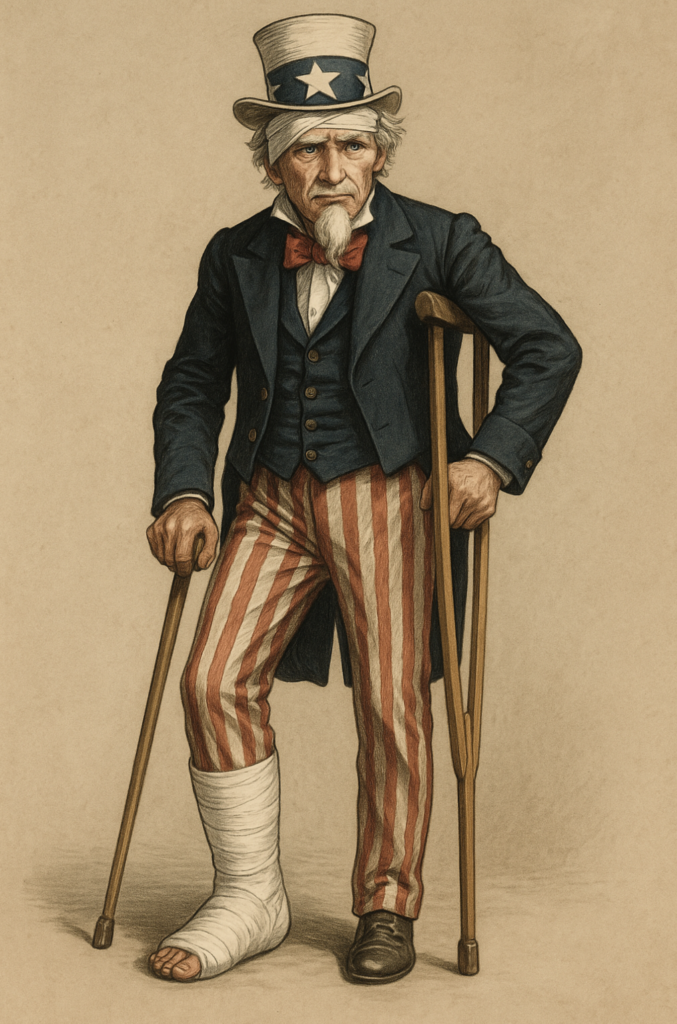
How to Fix the Nation
Restore Government Of, By, and For the People
Economic Background
- Overrule Citizens United and overthrow the Rule of Money. Reduce the Influence of Large Political Spending. Modern campaigns require enormous financial resources.
The Supreme Court’s decision in Citizens United v. Federal Election Commission (2010) held that corporations, labor unions, and other organizations have a First Amendment right to make independent political expenditures.
Unlimited independent expenditures allow wealthy interests to exercise disproportionate influence over elections and public policy.
Many reform proposals seek to reduce that influence through constitutional amendment, future judicial reconsideration, expanded disclosure requirements, or public financing of elections.
The goal is not to silence political debate but to strengthen public confidence that elections are decided primarily by voters rather than by financial resources. Getting big money out of politics could open public office to true patriots again who would restore the government of the people, by the people, and for the people.
- End Trickle-Down Returning to pre-Reagan/Bush/Trump tax rates would free up vast wealth — enough to:
- Give us far better benefits
- Fully fund the needs and responsibilities of our great nation.
- Pay down the national debt and begin recovery from trickle-down.
- Impeach Trump. His trade war and the Iran war are endangering the postwar system of international cooperation that the United States helped create after World War II — a system built to encourage trade, restrain aggression, stabilize the world economy, and prevent another global catastrope. He must be stopped and removed from office
He is accelerating climate change.
In Federalist Paper No. 65, Hamilton made clear that impeachable acts must involve “the abuse or violation of some public trust” and “relate chiefly to injuries done immediately to the society .” By extending trickle down (supply side) economics, Trump participated in fleecing over $50 trillion from the working class. That certainely Injured society. - Stop the Iran War The war with Iran has become one of the most consequential international crises of the decade. Beyond the military battlefield, the conflict has produced enormous human suffering, economic disruption, legal controversy, and growing fears of wider regional or even global escalation.
The war is unjust, illegal under both U.S. and international law, harmful to civilians, damaging to the world economy, and dangerous to global peace. - Stop the bombing of Lebanon. Lebanon has become a second front of the Iran war. After Hezbollah fired on Israel on March 2, 2026, Israel launched air strikes across Lebanon and, on March 16, sent ground troops into the south. More than 4,000 people have been killed and about a million driven from their homes. Strikes have continued despite a temporary ceasefire declared on April 16; on September 7, a strike on a residential building in southern Lebanon killed at least 11 people, including two children and two medics. UN agencies report that nearly a quarter of the population faces acute hunger. The United States is not bombing Lebanon itself, but it shapes the war through its support and weapons for Israel. Trump reportedly said Lebanon was not part of the April U.S.–Iran ceasefire. Any peace deal must include Lebanon, and U.S. weapons must come with real protections for civilians. Sources: Wikipedia, UN News, CNBC.
- Stop the ICE raids. End the killings of innocent people and other violations of Constitutional rights. There is substantial evidence that constitutional violations have occurred during some ICE raids. Documented examples include:
- Entering homes without a judicial warrant or valid consent.
- Detaining workers in mass workplace raids without individualized suspicion.
- Stopping people because they appear Latino, speak Spanish, work in particular occupations, or happen to be in immigrant neighborhoods.
- Arresting or detaining U.S. citizens.
- Denying detainees timely access to lawyers.
- Using unreasonable or excessive force.
- Interfering with journalists, protesters and people observing enforcement operations.
- It is not possible to calculate a reliable nationwide percentage of ICE operations involving constitutional violations. ICE does not maintain or publish a complete national database of unlawful stops, mistaken citizenship arrests, warrantless entries, excessive-force complaints and judicial findings.
- Nevertheless, the available evidence shows that violations are not merely hypothetical or confined to one isolated incident. Courts, the Government Accountability Office, government records and civil-rights investigations have found recurring problems. Some local studies have found extremely high apparent violation rates, although those studies cannot automatically be generalized to every ICE office or every raid nationwide.
The most responsible conclusion is:
Constitutional violations during ICE operations are documented and recurrent, but their exact national frequency remains unknown because the government does not adequately track or disclose them.
- Stop the ICE prison-building program. For much of its history, the United States has been known as a nation of immigrants and a place of refuge. Millions of people have come to America seeking freedom, safety, opportunity, and a better life for their families. While every nation has the right to enforce its immigration laws and maintain secure borders, many Americans question whether building a vast new network of immigration detention facilities is consistent with our nation’s history, values, and long-term interests.
Critics argue that expanding ICE detention centers will cost taxpayers billions of dollars, increase reliance on prolonged detention, and further shift America’s image from a welcoming nation to one defined by incarceration. They contend that Congress should instead invest in efficient immigration courts, timely asylum decisions, humane alternatives to detention, and secure but fair border management. - Restore the Voting Rights Act
The Voting Rights Act of 1965 was one of the most effective civil-rights laws in American history. It was needed because, for nearly a century after the Fifteenth Amendment, many states—especially in the South—used literacy tests, poll taxes, intimidation, violence, registration tricks, and discriminatory election rules to keep Black citizens from voting. Earlier lawsuits and civil-rights laws helped only slowly because every discriminatory rule had to be challenged one at a time.
The Act changed that. It banned many discriminatory voting practices, authorized federal examiners, strengthened federal enforcement, and—most importantly—required certain jurisdictions with histories of discrimination to get federal approval before changing voting rules. That system was called preclearance. It was effective: Black voter registration and political representation rose sharply in many areas after 1965.
Its great achievement was not merely that more people registered to vote. It changed the political structure of the country. It allowed millions of citizens who had been excluded from democracy to participate in it.
The Supreme Court weakened the Act because a majority concluded that some of its strongest tools were no longer justified, or that they conflicted with constitutional principles involving federalism, equal state sovereignty, and equal protection. Critics argue that the Court ignored Congress’s evidence and underestimated the persistence and adaptability of voting discrimination.
Recent state laws have demonstrated that the Act is still needed and that the Constitution is weaker without it.
The Act could be restored by Congress through a new coverage formula, stronger standards for Section 2 cases, national voting-access standards, state voting-rights acts, and clearer rules against racial discrimination in redistricting and election administration. - Impeach the justices who gutted the Voting Rights Act:
>The 15th Amendment to the Constitution guarantees equal representation but has no provision for enforcement.
>The Voting Rights Act provided the necessary enforcement.
>Gerrymandering is a powerful tool that was used during the Jim Crow era (before the Voting Rights Act) to deny equal equal representation.
>The fact that states resumed gerrymandering immediately after The voting rights Act was weakened by the Louisiana v. Callais ruling is irrefutable evidence that the Constitution was also weakened.
>By voting for the ruling, justices Alito, Roberts, Thomas, Gorsuch, Kavanaugh, and Barrett violated their oaths to uphold the Constution. >They should be impeached. - .Abolish the Electoral College. We need a constitutional amendment providing for presidential election by national popular vote. A democracy should treat each citizen’s vote as equal, regardless of state.
Back to Home Page
Back to “We’ Been Had” email
Back to Message Congress tool